The Quiet Cost of Getting It Right
There is a version of you that everyone trusts. The one who shows up prepared. The one who holds the room, holds the family, holds the business together with steady…


I used to treat airports like a game to win. If I could time things perfectly, arrive late, breeze through security, and walk straight onto the plane, I felt like I had hacked the system. Waiting at the gate felt like wasted existence. I saw that in-between time as dead space, something to minimize or outrun.
Over the years, and especially through the work I have done with presence and the Mirrors, I have realized how backwards that was. When I rush, I lose myself. When I compress time, I compress my capacity to respond. And when I treat life like a race, I experience it like one.
These days our family travels differently. We build in space. We travel with time instead of against it. We walk through the experience with awareness rather than efficiency.
This trip, the Friday before Thanksgiving flying from Mexico to Phoenix, reminded me exactly why that shift matters.
Going through security in Mexico is always a breath of fresh air. Not because it is faster, but because the energy is lighter. They take their work seriously, but there is no tension, no hostility. We always opt out of the scanners and request a manual pat-down, and in Mexico that is never an issue. A quick smile, a simple “revision manual,” a very gentle pat-down, and we are through without drama or suspicion.
It is a stark contrast to what happens in the United States.
We landed in Houston, walked toward customs, and I could already feel the air change. Heavier. Thicker. A subtle sense of interrogation before a word was spoken. As an American citizen, it still surprises me how stern the tone can be, as if reentering your own country requires justification. Other countries do not greet you this way. But in the U.S., this rigidity has become normal.
After baggage claim we looped back through TSA to re-enter security. The line was short, maybe ten people ahead of us, and I was grateful we had given ourselves plenty of time. No rush. No hurry. Just moving through the steps.
I approached the agent with a smile and said, “Three opt-outs for manual pat-down. Two male, one female.” He paused and said, “Okay. Just a moment.” That moment became five minutes as we stood to the side waiting for someone to appear. When someone finally did, everything shifted again.
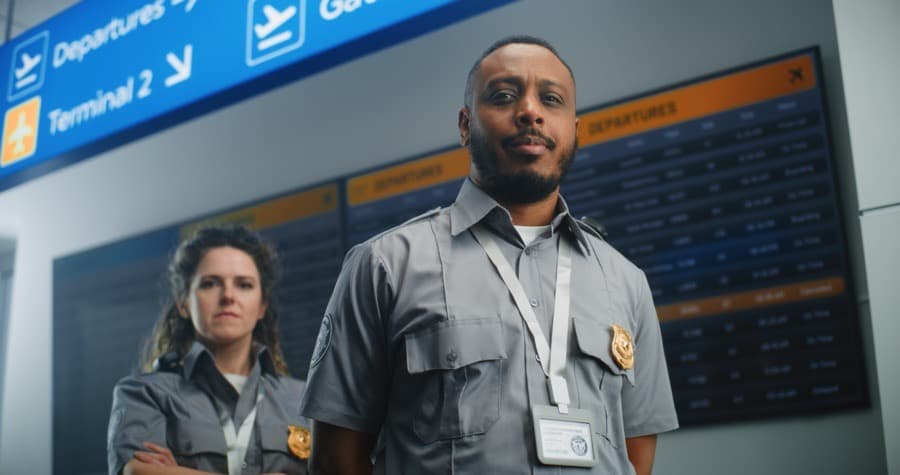
He walked toward us with a look that could cut straight through you. A large, solid man, probably in his thirties, carrying a mood that entered the room before he did. He had the kind of presence that suggested he was wrestling with something internally and the kind of expression that said he was not in the mood for anything outside the script in his head.
He looked at Kim and said, “It will be at least 30 minutes before we get to you.” It was not information. It was a test to see if we would cave and step through the scanner.
Kim smiled. “That is fine. We have plenty of time.”
That answer disrupted whatever expectation he had.
Then he turned to me. “Come with me, sir.”
He ran through the required TSA script, the standard explanation of the procedure, the back-of-hand statement, and the consent line. But he did not speak it like a script. He spoke it like an accusation. He stared with an intensity completely out of proportion to the moment. I wondered whether he expected me to crack or react.
And then the pat-down began.
I have had a hundred of these. This was not that. He used so much force on my arms and legs that I lost balance more than once. He pressed down each limb like he expected contraband to be fused beneath my skin. He told me to remove my jewelry, three necklaces, and hold them in my right hand, perfectly still, like a TSA ritual designed to test compliance.
At one point he said, “Lift your shirt.” I lifted it all the way up, exposing my entire stomach, because when someone barks a vague instruction, you follow the literal version. A younger TSA agent across the lane looked at me, laughed, and said, “Sir, put your shirt down.” I shrugged and said, “He told me to lift it.” The agent doing the pat-down did not appreciate the humor and continued with even more force.
Through all of this, I could see my family. Kim was watching with calm patience. Dylan was watching with an expression somewhere between disbelief and trying not to laugh.
The man was not doing a job. He was performing something. Testing something. It felt like he wanted a reaction, whether indignation, anger, or resistance, anything he could interpret as a confirmation of whatever story he had already formed about me.
“Stand still. Do not move,” he said again, too intense for the moment.
I could have reacted. I could have pushed back. I could have filed a complaint and had legitimate grounds. But none of that would have given me what I wanted most, which was to remain myself. I chose stillness. I chose humor. I chose not to let someone else’s storm become my weather.
When he finished, he snapped again: “Keep your jewelry in your right hand.” I almost laughed. Of course it had to be the right hand. He tested his gloves, cleared me, and sent me on my way with a curt nod.
The same agent called my son next. Dylan told me afterward that it was all he could do not to crack up completely. He got the same rough treatment, the same intensity, the same humorless seriousness. He held it together, barely. At one point our eyes met with the kind of silent father-son language that says, Can you believe this, and Just breathe through it.
She was the last one called back. By this time, Dylan was still in the thick of his pat-down, halfway through the full treatment. Kim appeared moments later already done. Her pat-down took a fraction of the time. Straight in, straight out, no drama. It highlighted just how exaggerated ours had been.
If we had rushed that day, if we had cut it close or watched the clock, the entire experience would have felt threatening and chaotic. The only reason we could laugh instead of panic was because we had built in time. When you create space, you create choice. When you have time, you have breath. And when you give yourself breathing room, you can field the unexpected without losing who you are.
Spaciousness is not about being slow. It is about being steady enough to choose how you want to meet the moment.
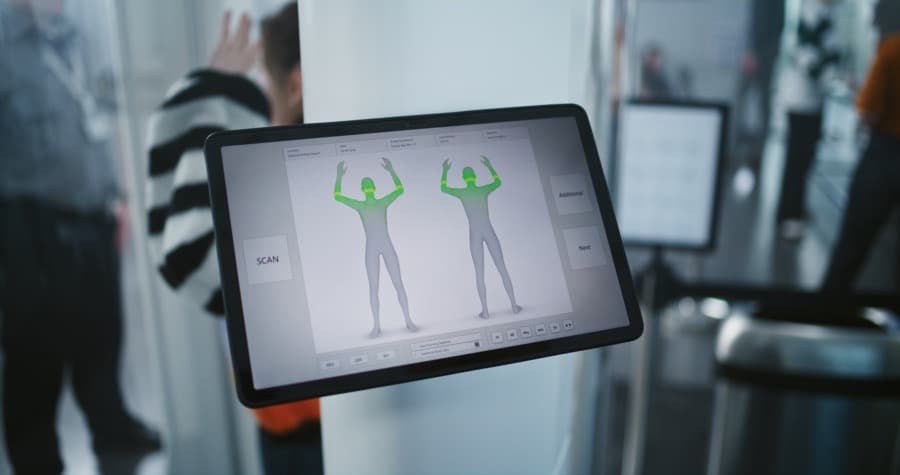
I am not here to tell anyone what choice to make, but I do think it is important to know that this technology is not neutral. Full-body scanners have raised two big concerns over the years: possible health risks and very real privacy issues.
Earlier generations of scanners used backscatter X-rays, which expose the skin to ionizing radiation. Some researchers and physicians have warned that there is no reason to expose people to ionizing radiation without a clear medical benefit, and they have questioned the lack of long-term safety studies. Those backscatter X-ray scanners were eventually banned in Europe and phased out in the United States, in part because of both health and privacy concerns.
Today, most U.S. airports use millimeter-wave scanners, which rely on non-ionizing radiation. Official agencies describe the doses as extremely low and unlikely to cause harm, but even in recent years some experts still point out that we do not have deep, long-term data on repeated exposure over a lifetime.
On top of that, there is the question of privacy. Full-body scanners have a documented history of producing images that feel like “virtual strip searches,” and there has been ongoing concern about how detailed those images are, who sees them, and whether they can be stored or misused.
If you want to read more, here are a couple of starting points:
“Radiation exposure and privacy concerns surrounding full-body scanners in airports”
Journal of Radiation Research and Applied Sciences (2014)
“Is That Airport Security Scanner Really Safe?”
Scientific American (2017)
We choose the manual pat-down because it feels safest, most respectful of our bodies, and most aligned with our values around health and privacy. It is a personal choice, and this is the one that lets us sleep best at night.
This TSA moment was a living example of how the Mirrors work in real life. The man’s behavior could have pulled me into anger or defensiveness, but spaciousness and awareness gave me room to choose differently.
Presence
Stillness
Response over reaction
These are not theories. They are practices you can carry into places as ordinary and unpredictable as an airport checkpoint.
I walked away from that pat-down more centered than shaken. The situation did not change, but my relationship to it did. That is the part we get to control.
Here is why I stayed grounded
(again, not because the situation changed, but because my relationship to it did):
That is the work. That is the Mirror. And that is available to anyone willing to pause long enough to choose it.
The next time you are in line at a coffee shop, stuck in traffic, or dealing with someone who seems intent on pulling you into their storm, try this:
Small practices like these reshape how you move through the world. They do not make life easier, but they make you steadier. That steadiness is its own kind of freedom.
Experiences like this are one of the reasons I’m writing The Seven Mirrors. The book goes much deeper into the practices behind presence, response, and staying steady in the middle of real life. Moments like a tense airport checkpoint are everyday opportunities to walk what we remember.
If this story resonates with you, the full book will be released this coming spring. Consider this a small window into the work and a preview of what’s ahead.